


News
more+- Professor Chen Erfan, a leader of our company, was invited to attend the inauguration ceremony for the new location of Shenyang Zhilang Technology Co., Ltd. and visited its research achievements and new products.
- The 4th Annual Meeting of the Special Committee and the 3rd New Materials Science & Technology Conference Held in Hangzhou
- Professor Chen, a leader of our company, participated in the Standardization Technical Committee of the Chemical Industry and Engineering Society of China.
- Warm Congratulations on Our Company Being Awarded the Certificate of High-Tech Enterprise!
- Chairman Chen Erfan Participated in Liaoning International Rubber Technology Exchange Festival as a Specially Invited Expert.
contact
more+Contact Phone:13147811246 13147811216
Landline:13147811246 13147811216
Corporate Email:tech@rdpmcn.com
Address:Hongfa International, Shenliao Road, Tiexi District, Shenyang City, Liaoning Province, P.R.China
Sales Phone:13147811246 13147811216
News
Comparative Analysis of the Hazards of Steel Dams in Domestic Air - shield Dams
发布时间:2020-11-16
点击量:3685
Today, I'll introduce to you a comparative analysis of the potential hazards of steel dams within domestic air - shield dams. Friends who want to know more, come and learn in detail!
1. Reliability Analysis
Generally, a rubber dam usually requires the construction of an air - supply station or a pump house, with a large number of complex pipelines. However, a steel dam is only equipped with two driving devices. This type of driving device is a new - style one. It has a simple structure and is easy to operate. There is no need for auxiliary facilities like oil pipes and pumping stations. Moreover, this driving device is equipped with a manual operation mechanism. In case of power outages or other malfunctions, it can be manually operated with just 5 kg of force. This effectively ensures that the dam can be lowered or raised as required, demonstrating a high level of reliability.
2. Winter Freezing Problems
Based on the "Design Specifications" and practical usage of rubber dams in domestic air - shield dams, once ice forms in winter, ice - breaking work must be carried out. Otherwise, it will cause fatal damage to the rubber dam. The ice - breaking work is completely manual, which is time - consuming, labor - intensive, and brings great inconvenience to management. When the ice thaws in spring, ice floes cannot overflow on the rubber dam, and the solid and sharp ice is likely to tear the rubber dam. In winter, if the steel dam is set at an inclined angle, when ice forms, the ice layer can extend upward along the slope, effectively releasing the expansion force generated by the freezing of water. As a result, the steel dam will not be damaged. Additionally, due to the hardness of the steel itself, during the spring ice - flood season, floodwater can be discharged over the dam crest, allowing the steel dam to endure winter easily.
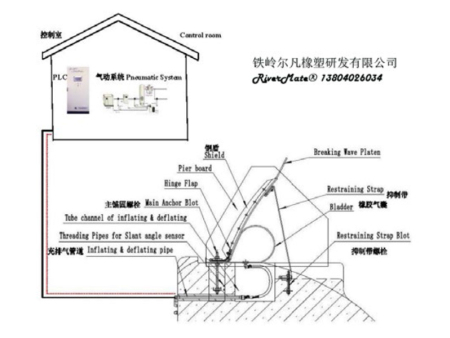
3. Anti - corrosion Issue
The surface of the steel dam is hot - sprayed with zinc in accordance with the "Standard Specifications for the Manufacture of Steel Gates in Water Conservancy and Hydropower Projects". The adhesion is extremely strong. The results of institutional research indicate that when the flow velocity of sand is 8 ≤ m/s, it will not damage the zinc layer. The flow velocity of general rivers is unlikely to reach this speed.
4. Sedimentation Issue
The steel dam is a special - structured dam - gate form. It has no bottom gate slots and side gate slots, and it is a structure in which the gate leaf rotates around the bottom axis. The upstream water stop presses on the circular shaft. When the dam is erected or lowered, the water stop does not leave the surface of the circular shaft, always maintaining a sealed water - stop state. The side water stop works on the same principle, and the water - stop surface never leaves the side breast wall (stainless - steel embedded parts or marble). Therefore, sediment (mud) will not affect the raising and lowering of the steel dam. For areas with serious sedimentation, a sand (mud) - blocking sill and a bell - mouth are generally set in front of the dam. Firstly, this can effectively block large stones. Secondly, when the dam is lowered for flood discharge, the flow velocity at the dam opening is increased, enabling the sediment - water mixture to be directly washed downstream by the flood. In northern regions, the main function of the dam is to store water when erected. Since the dam is erected for a relatively long time, sedimentation is likely to occur. However, the steel dam topples downstream around the bottom axis. Therefore, when the dam is lowered, the deposited sediment is washed downstream by the water flow and is unlikely to cause blockage. Additionally, after flood discharge, we can analyze the amount of sediment (mud) deposited on the gate body according to the local sediment content, and calculate the lifting force required for raising the dam based on the amount of sediment (mud), fully considering the force needed to overcome the sediment (mud) when raising the dam.
5. Energy Consumption Comparison
The power consumption of a 100 - m rubber dam requires a power load of at least about 100 kw/hour, and each time it takes about 2 - 3 hours to raise the dam. The steel - dam gate saves a significant amount of electricity consumption compared to the rubber dam every year.
6. Impact on Flood - discharge Cross - section
The design specifications for rubber dams in domestic air - shield dams require the bottom sill of the dam to be 20 cm high. Moreover, when the dam is lowered, the water in the rubber dam cannot be completely drained, forming a height of not less than 20 cm. The sum of these two factors results in a water - blocking cross - section of not less than 40 cm in the river cross - section when the dam is lowered, seriously affecting the flood - discharge flow. The steel dam has no such impact.
In conclusion, this is all for the content about domestic air - shield dams for now. I hope it can be helpful to you. If you want to know more, you are welcome to follow us!