

SERVICE PHONE

13147811246 13147811216

Product

Current Location:Home-Product

Plastics, Modified Materials and Products

Release Date:2026-01-13 Page Views:115
Plastics, Modified Materials and Products

Plastics are a type of materials made from synthetic or natural polymers. They can be freely molded into various shapes and finally retain those shapes, or they refer to plastic - formable material products.

Characteristics

Light in weight, stable in chemical properties, water - resistant, non - corrosive, good toughness (excellent impact resistance), good insulation, low thermal conductivity, relatively good wear resistance, good formability and colorability (beautiful in color), and low processing cost; it can have good transparency and significant physical property variations.

However, most plastics have poor heat resistance, a large coefficient of thermal expansion, are flammable, have poor dimensional stability, are prone to deformation, have poor low - temperature resistance, are prone to aging, and some plastics are soluble in solvents.

Plastics can be classified into two categories: thermosetting (three - dimensional network structure) and thermoplastic (linear structure).

1768442203483468.png


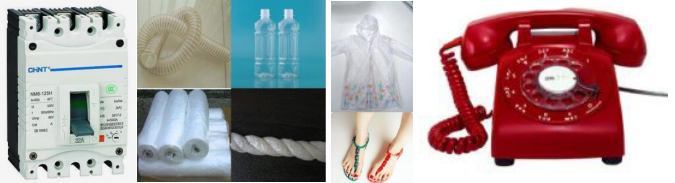
Thermosetting plastics and their products

Thermosetting plastics are plastics that solidify under certain temperature and pressure or under the action of curing agents, ultraviolet light, etc., to form insoluble and infusible properties. Once cured, thermosetting plastics no longer have plasticity (cannot be processed again), have high stiffness, high hardness, stable dimensions, and relatively high heat resistance. However, when the temperature is too high, they will be decomposed and damaged. Common thermosetting plastics include phenolic resin, urea - formaldehyde resin, melamine resin, unsaturated polyester, epoxy resin, amino resin, silicone plastics, etc.
The main processing methods include compression molding, extrusion molding, injection molding, and casting production processes.
They are mainly applied in electrical equipment, household appliances, tableware, office equipment, automobiles, and industrial machinery.

1768442256370408.png


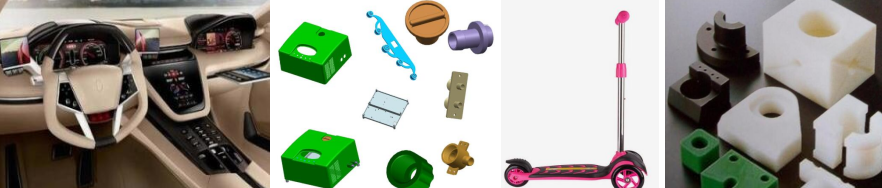
Thermoplastic plastics and products

Thermoplastic plastics can be processed repeatedly. They have a relatively large physical elongation rate, ranging from 50% to 500%. Under forces at different elongation rates, the changes are not completely linear. Commonly used thermoplastics include polyethylene, polypropylene, polyvinyl chloride, polystyrene, polyoxymethylene, polycarbonate, polyamide, acrylics, other polyolefins and their copolymers, polysulfone, polyphenylene oxide, chlorinated polyether, etc.
The main processing methods include extrusion, injection molding, hot compression molding, and blow molding.
They are widely used in fields such as automobiles, electronics and electrical appliances, home appliances, sports, medical care, and industrial parts.

1768442657701634.png


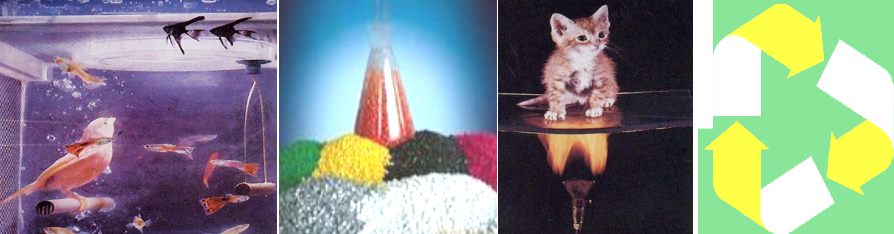
Plastic modified materials and products

Plastic modification aims to improve or enhance the original properties of resins through physical, chemical, mechanical and other approaches. This includes aspects such as improving mechanical properties, electromagnetic properties, chemical properties, corrosion resistance, aging resistance, wear resistance, thermal properties, flame retardancy, barrier properties, density, hardness, precision, appearance, processability, transparency, and cost - effectiveness. Plastic modification is the most effective way to reduce costs and improve performance.
The processing methods include extrusion, injection molding, hot compression molding, blow molding, etc.
Our company has developed a series of modified materials and products based on PE, PP, PVC, nylon, ABS, POM, etc.
Features: Reinforced, toughened, antistatic, with good surface gloss and low cost.

1768442682422605.png