

News
more+- Professor Chen Erfan, a leader of our company, was invited to attend the inauguration ceremony for the new location of Shenyang Zhilang Technology Co., Ltd. and visited its research achievements and new products.
- The 4th Annual Meeting of the Special Committee and the 3rd New Materials Science & Technology Conference Held in Hangzhou
- Professor Chen, a leader of our company, participated in the Standardization Technical Committee of the Chemical Industry and Engineering Society of China.
- Warm Congratulations on Our Company Being Awarded the Certificate of High-Tech Enterprise!
- Chairman Chen Erfan Participated in Liaoning International Rubber Technology Exchange Festival as a Specially Invited Expert.
contact
more+Conductive, Thermal and Magnetic Functional Polymer Materials
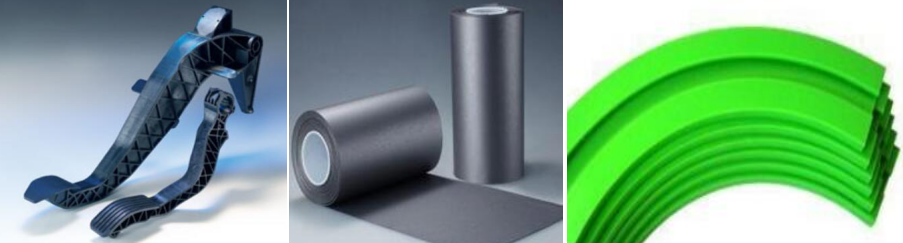
l Conductive polymer materials
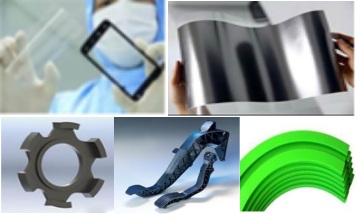
| Conductive polymer materials are a type of polymer materials whose electrical conductivity is close to that of metals or semiconductors. Their unique electromagnetic properties, mechanical plasticity, corrosion resistance, and low cost have attracted widespread attention. They are widely used in various fields such as electronic devices, electromagnetic shielding, metal anticorrosion, polymer batteries, conductive rubber, transparent conductive films, medicine, biosensors, electrochromic devices, and information storage materials. |  |
Our company has developed a series of composite conductive and semiconductor polymer materials.。
Technical characteristics
Conductive and Antistatic Rubber Sheet | Polyolefin Conductive Material | Conductive Composite Material | ||||
Performance | Data | Performance | Data | Performance | Data | |
Hardness (Shore A) | 40‑75 | Hardness (Shore D) | 40‑70 | Impact Strength / J/m | 50~100 | |
Tensile Strength / MPa | ≥5.0 | Breaking Strength / MPa | 20‑50 | Yield Strength / MPa | 50‑70 | |
Hot‑air Aging (70°C×72h)Tensile Strength Reduction Rate / % | ≤25 | Elongation / % | 100‑200 | Young’s Modulus / MPa | 1500‑2000 | |
Compression Set / %(25% Compression Ratio, 23°C×24h) | ≤25 | Density | 1‑2.2 | DC Conductivity / S/cm | 10⁻⁷ | |
Water Absorption / mg/cm³(23°C×68h) | ≤4.0 | Heat‑Resistant Temperature / °C | 120‑220 | AC Conductivity / S/cm | 10⁻⁷~10⁻¹⁰ | |
Resistance / Ω | ≤5×10⁴ ~ | 10⁴⁻⁸ | Volume Resistivity / Ω·cm | 10¹⁻³ | Dielectric Constant (100Hz) | 10‑150 |
l Thermally conductive polymer materials
| With the rapid development of high - tech fields such as aviation, aerospace, electronics and electrical appliances, polymer materials with high thermal conductivity are in demand. These materials possess excellent comprehensive properties including high - voltage insulation, light weight, easy processing, low coefficient of thermal expansion, shock absorption, a wide range of base materials for selection, and thus are widely applied. | 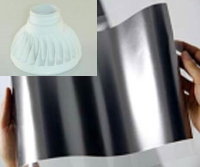 |
Our company has developed a series of composite thermally conductive polymer materials.
Technical characteristics
Thermally Conductive Thermoplastic | Thermally Conductive Engineering Plastic | Thermally Conductive Elastomer | |||
Performance | Data | Performance | Data | Performance | Data |
Hardness (Shore A) | 40‑75 | Melt Flow Rate / g/min | 10~40 | Hardness (Shore A) | 50~80 |
Tensile Strength / MPa | >15.0 | Tensile Strength / MPa | ≥45 | Tensile Strength / MPa | 9~25 |
Elongation / % | >200 | Elongation / % | 100~200 | Elongation / % | >300 |
Notched Impact Strength / kJ/m² | >20 | Notched Impact Strength / kJ/m² | 20~230 | Tear Strength / kN/m | >50 |
Heat‑Resistant Temperature / °C | 90~130 | Heat‑Resistant Temperature / °C | 120~220 | Wear Ratio / % | 0.1~0.3 |
Thermal Conductivity / (W/m·K) | >1 | Thermal Conductivity / (W/m·K) | 0.8~1.5 | Thermal Conductivity / (W/m·K) | 0.8~1.5 |
Thermal Conductivity of Common Plastics
Polymer Material | Thermal Conductivity / (W/m·K) | Polymer Material | Thermal Conductivity / (W/m·K) |
LDPE | 0.30~0.34 | ABS | 0.15~0.20 |
HDPE | 0.30~0.53 | TPU | 0.19 |
UHMWPE | 0.41~0.51 | PET | 0.15 |
PP | 0.11~0.17 | PC | 0.19~0.21 |
PS | 0.10~0.15 | PVC | 0.13~0.29 |
Nylon‑6 | 0.22~0.33 | Nylon‑6,6 | 0.24~0.33 |
l Magnetic polymer materials
| Ferrite magnetic materials are generally made through secondary sintering. The sintering temperature is as high as about 1200℃. They are hard and brittle, with large deformation. It is difficult to make products with complex shapes and high - dimensional accuracy, and the yield rate is relatively low. Composite magnetic polymer materials have emerged as a new force. They can be used to prepare small - sized and special - shaped permanent magnets, and are widely applied in fields such as intelligent control, wave - absorbing materials, electronics and electrical appliances, biomedicine, and office supplies. Compared with sintered magnets, they have advantages such as low energy consumption, low density, stable magnetism, easy processing and molding without shape restrictions, no need for post - processing, high - dimensional accuracy, good flexibility, high output, and low cost. | 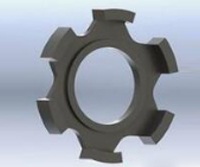 |
Our company has developed a series of composite magnetic polymer materials.
Technical characteristics
PA Magnetic Material | Elastomer Magnetic Material | ||
Performance | Data | Performance | Data |
Maximum Magnetic Energy Product (BH)max / MGOe | 1.5~5.0 | Hardness (Shore A) | 50‑85 |
Residual Magnetic Flux Density (Br) / kGs | 2.5~4.5 | Tensile Strength / MPa | 10~20 |
Intrinsic Coercivity (iHc) / kOe | 3.0‑4.0 | Elongation / % | >300 |
Melt Flow Rate / g·10min | 80~120 | Maximum Magnetic Energy Product (BH)max / MGOe | 2.0~6.0 |
Flexural Strength / MPa | 30‑50 | Residual Magnetic Flux Density (Br) / kGs | 7.6~19 |
Notched Impact Strength / kJ/m² | 3~5 | Intrinsic Coercivity (iHc) / kOe | 10.5~25.12 |