

News
more+- Professor Chen Erfan, a leader of our company, was invited to attend the inauguration ceremony for the new location of Shenyang Zhilang Technology Co., Ltd. and visited its research achievements and new products.
- The 4th Annual Meeting of the Special Committee and the 3rd New Materials Science & Technology Conference Held in Hangzhou
- Professor Chen, a leader of our company, participated in the Standardization Technical Committee of the Chemical Industry and Engineering Society of China.
- Warm Congratulations on Our Company Being Awarded the Certificate of High-Tech Enterprise!
- Chairman Chen Erfan Participated in Liaoning International Rubber Technology Exchange Festival as a Specially Invited Expert.
contact
more+Intelligent elastic anti-collision device
1. Appearance and Dimensions
Device Model
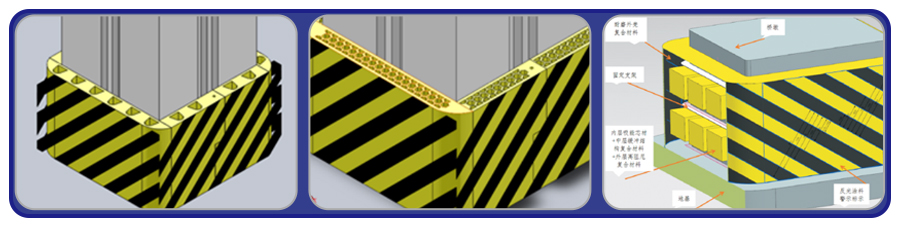
Device Features
Protection Performance
Computer simulation and finite element analysis were carried out based on test data, combined with real vehicle and bridge pier structures. Simulations of vehicle collision with bridge piers and vehicle collision with the device were performed. The calculation results are shown in the figure.

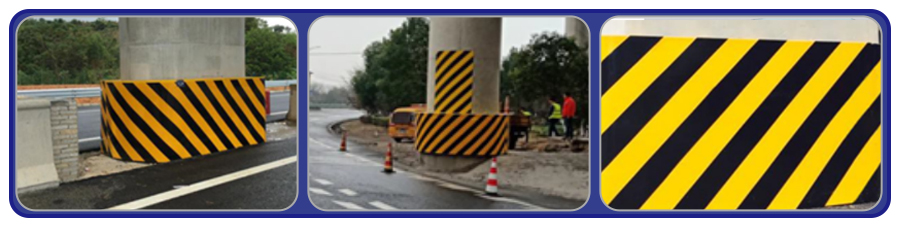
Application Cases
Technical Parameters
Item No. | Technical Index Item | Testing Standard |
Fiber Reinforced Composite | 1. Tensile strength≥250MPa; 2. Tensile modulus≥2.5GPa; 3. Compressive strength≥200MPa; 4. Flexural strength≥250MPa; 5. Shear strength≥50MPa; 6. Barcol hardness of the shell≥45。 | 1. GB1446-2005《Test Methods for Properties of Fiber Reinforced Plastics》 2. GB50608-2010《Technical Code for Application of Fiber Reinforced Composite in Construction》 3. GB/T1447-2005《Test Method for Tensile Properties of Fiber Reinforced Plastics》 4. GB1449-2005《Test Method for Flexural Properties of Fiber Reinforced Plastics》 5. GB/T3355-2005《Test Method for In-plane Shear of Fiber Reinforced Plastics》 6. GB/T1463-2005《Test Method for Density and Relative Density of Fiber Reinforced Plastics》 7. GB/T2577-2005《Test Method for Resin Content of Glass Fiber Reinforced Plastics》 8. GB/T3854-2005《Test Method for Barcol Hardness of Reinforced Plastics》 |
Polymer Closed‑cell Core Material | 1. Shear strength≥0.15MPa; 2. Compressive modulus≥3MPa; 3. Compressive strength≥0.15MPa; 4. Water absorption≤3%。 | 1. GB/T8810-2005《Determination of Water Absorption of Rigid Cellular Plastics》 2. GB/T10007-2008《Test Method for Shear Strength of Rigid Cellular Plastics》 3. GB/T1453-2005《Test Method for Flat Compression Properties of Sandwich Constructions or Cores》 |
Overall Performance of Composite Anti‑collision Block | 1. Appearance dimensions: Deviations in length, width, diameter, height and other dimensions shall not exceed 5% of the design dimensions; 2. Service life: No less than 20 years; 3. Appearance flatness: < 10 mm. | JT/T1061-2016《Attached Flexible Anti-vehicle-collision Devices for Bridge Piers》 |
On-site Acceptance Standard | The on-site supervisor shall inspect the product’s appearance dimensions, color and installation position against the relevant construction drawings to ensure construction in accordance with the drawings, with errors within the allowable range. | |
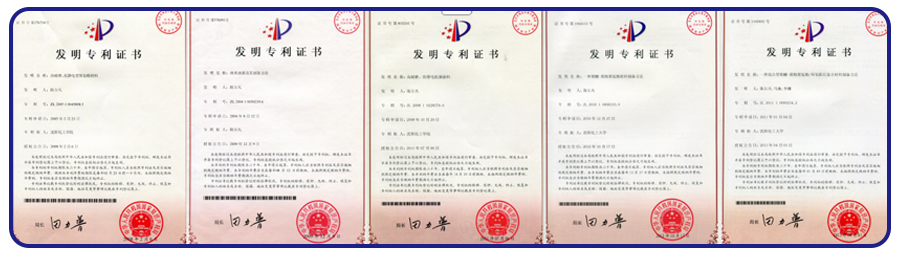
Related Patents
Patent Type | Patent Name | Patent Number |
Invention Patent | High Wear-Resistant and Antistatic Polyurethane Material | ZL2005100458985 |
Invention Patent | Nano Paint and Its Preparation Method | ZL200410050239.6 |
Invention Patent | High Wear-Resistant, Antistatic and Antibacterial Coating | ZL200810228379.6 |
Invention Patent | A Preparation Method of Polyether-Polyester Polyurethane Material | ZL2010106063330 |
Invention Patent | A Preparation Method of Hybrid Polyether-Polyester Polyurethane/Epoxy Damping Composite Material | ZL2011100002342 |